The Atomic Anxiety team are working with friends and colleagues from across the University of Glasgow and beyond to host the Popular Culture and World Politics conference at the University of Glasgow in November 2026! Please see below for the call for papers for PCWP v17:
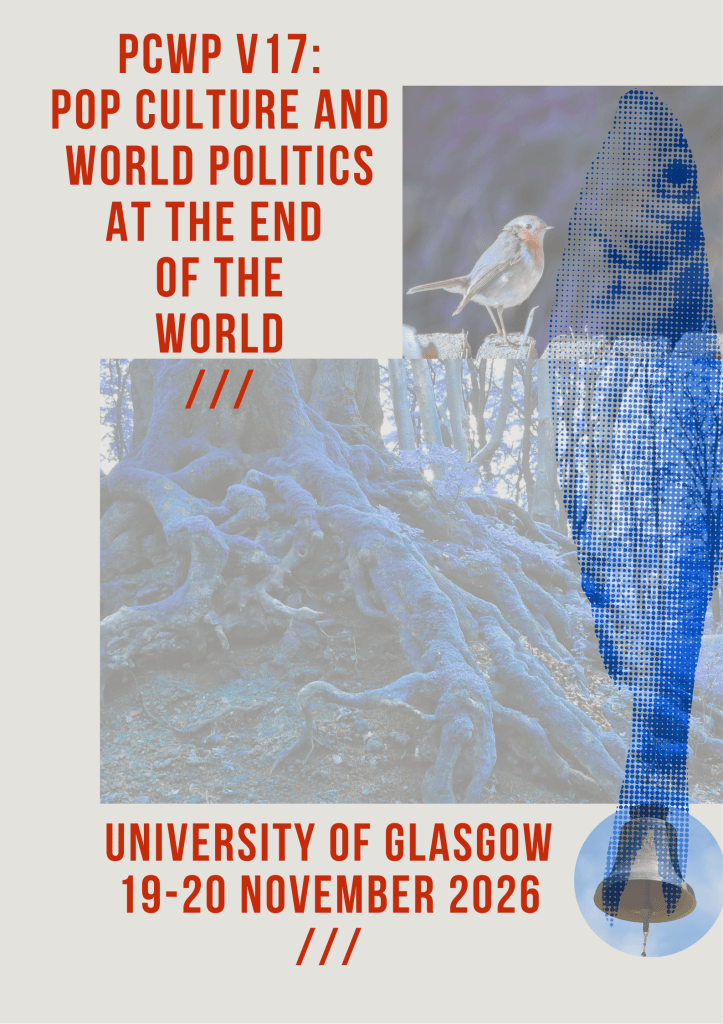
Pop Culture and World Politics at the End of the World
University of Glasgow, 19-20 November 2026
The University of Glasgow is delighted to host the annual Popular Culture and World Politics (PCWP) conference in 2026, which comes to Glasgow for its seventeenth iteration. The organising committee of PCWP v17 invites scholars and practitioners working on the intersections of popular culture and world politics to submit abstracts to the two-day event.
We welcome submissions on all aspects of popular culture and world politics. Though, we are particularly keen to hear from those who are exploring how popular culture constructs, makes sense of, critiques, resists, and/or challenges world politics at a moment widely framed as one of endings, collapse, breakdowns, and radical transformations.
In an era marked by a dissolving international order, revisionist interventionism, neo-imperialism, rising authoritarianism, genocide, right wing populism, cascading inequalities, climate chaos, and an increase in existential threats, we invite proposals for roundtables, papers, and other contributions that examine the “end of the world” and pop culture and world politics.
Across film, television, games, music, social media, memes, fashion, AI-generated content, and other everyday cultural practices, popular culture grapples with planetary crisis, political violence, democratic erosion, nuclear risk, planetary catastrophe, technological acceleration, and imagined futures after collapse. These representations do not merely reflect global politics, but they inform how political actors, publics, and international institutions understand current and looming threats, shared responsibilities, and political possibilities.
PCWP v17 therefore welcomes contributions that examine popular culture and world politics in moments of perceived endings, whether apocalyptic and global, utopian and local, rapid and unforeseen, slow and predictable, uneven and hegemonic, or contested and marginal.
Submissions for individual paper presentations should not exceed 250 words. Roundtables of 4-5 participants should include a 300-500 word abstract on the topic, as well as the names and affiliations of the participants and individual contributions (where applicable). Panels of between 3-5 papers should include a brief (100-word) abstract and individual abstracts for each paper (not exceeding 250 words). We also welcome submissions that do not conform to the ‘usual’ formats of conference papers and presentations, so if you want to screen a film you’ve made, display your art, or run a creative session then please let us know.
Possible themes include (but are not limited to) pop culture, world politics and:
- Armageddon, apocalypse, catastrophe, and “end times”
- Climate crises, threats to biodiversity, environmental collapse, and planetary politics
- Nuclear war, extinction narratives, and existential threats to the world order
- Genocide, war, and political violence
- New, emerging, and disruptive technologies
- Artificial Intelligence and its impact in and on PCWP
- Borders, migration, and ontological security in chaotic times
- Memory, nostalgia, and the cultural politics of decline
- (Geo)political eutopias, utopias, and dystopias
- Resistance, hope, and alternative futures in popular culture
- Identity, race, gender, disability, and class in world-ending scenarios
- The politics of emotions, affect, and humour at the “end of the world”
- Theoretical and methodological innovations in pop culture and world politics
We welcome papers from across disciplines, including International Relations, Political Science, Cultural Studies, Media Studies, Sociology, Anthropology, Geography, History, Art, and beyond.
Contributions from early career researchers and PhD students, as well as contributors from beyond Europe and North America, and contributors from communities underrepresented in academia are particularly encouraged.
Submission details
- Abstracts of up to 250 words (individual papers), 300-500 words (roundtables), and 850-1,350 words (panels)
- Please include name, affiliation, and contact details
- Please submit your applications via this form.
- Deadline: March 31st 2026.
- Notification of acceptance: by end of April 2026
- Please note that this in an in person event.
PCWP v17 will be held in person at the University of Glasgow and will continue the conference series’ tradition of a welcoming, supportive, interdisciplinary, and intellectually innovative environment for all.
Any questions should be directed to Dr Rhys Crilley at rhys.crilley@glasgow.ac.uk.
PCWP v17 is made possible by support from the Atomic Anxiety in the New Nuclear Age Project and the University of Glasgow’s School of Social and Political Sciences.
 Atomic Anxiety in the New Nuclear Age