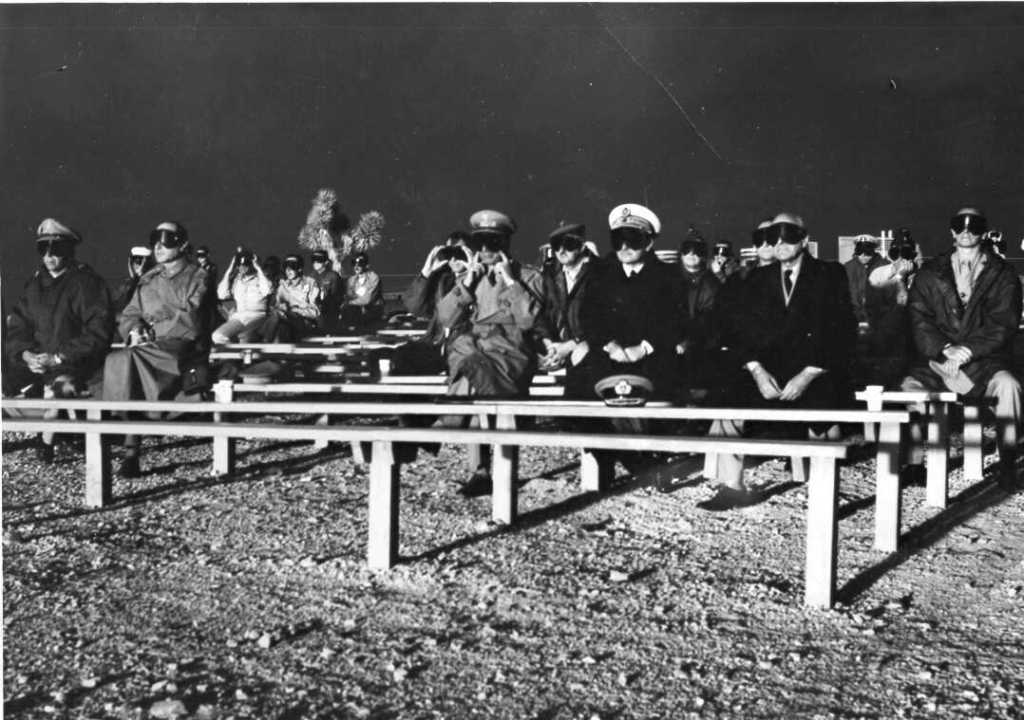
According to the Secretary General of the United Nations, the world has entered ‘a time of nuclear danger not seen since the height of the Cold War’. This dangerous ‘new nuclear age’ is the result of arms control treaties collapsing, rising tensions between nuclear weapon states, and threats to use nuclear weapons such as those made by Vladimir Putin, who has warned of ‘ominous consequences’ against anyone who opposes his invasion of Ukraine. At the same time, all of the nuclear weapon states are modernising or increasing their nuclear arsenals.
In this context of heightened atomic anxiety, the Atomic Anxiety in the New Nuclear Age project investigates how the legitimacy of nuclear weapons is communicated, constructed, and contested, and then examines how nuclear arms control and disarmament efforts can be improved based on these insights.
Despite the catastrophic potential of even a small nuclear conflict, states continue to maintain, modernise, and increase their nuclear weapons arsenals. Why?
This project addresses this puzzle and has two central aims.
First, it seeks to understand how and why states claim legitimacy for their nuclear weapons in this ‘new nuclear age’, as well as understanding how other political actors and members of the public consent to, acquiesce or challenge these claims.
Second, the project critically assesses how the risk of nuclear war can be mitigated through improving nuclear arms control and disarmament advocacy and mechanisms so that they gain more international support.
The Team
Dr Rhys Crilley
The Atomic Anxiety in the New Nuclear Age project is led by Dr Rhys Crilley at the University of Glasgow. Rhys has been awarded £1.1 million in funding through a prestigious UKRI Future Leaders Fellowship, and he will lead the Atomic Anxiety in the New Nuclear Age project over the next four years (2024-2028).
Rhys is the author of over 30 peer-reviewed articles and book chapters, and his first book Unparalleled Catastrophe: Life and Death in the Third Nuclear Age (Manchester University Press) was recently published. Whereas Unparalleled Catastrophe outlines the problems of the ‘new’ or ‘third nuclear age’, the Atomic Anxiety project seeks to provide solutions and work with states, NGO’s, and the public to implement them.
Rhys has published widely in the areas of critical security studies, international political communication, and nuclear politics.


Dr Carolina Pantoliano
Carolina joins the team as a Research Associate in Nuclear Arms Control and Disarmament, where she will be working closely with Dr Rhys Crilley to deliver innovative research and impact on nuclear politics and international security.
Carolina has recently completed her PhD at the University of Auckland, where her thesis drew upon feminist, poststructrual, and postcolonial approaches to examine the emergence of the Treaty on the Prohibition of Nuclear Weapons (TPNW).
Dr Carolina Pantoliano has already published research in leading academic journals such as International Affairs and Contemporary Security Policy, and she is currently writing her first book. Carolina is also a member of the Beyond Nuclear Deterrence Working Group, which is part of the Rethinking Deterrence Research Network, housed at Harvard University’s Belfer Centre for Science and International Affairs.
Admin Assistant
Gemma Gleed
Gemma Gleed supports the Atomic Anxiety project as the team’s Administrative Assistant. She is a member of the College of Social Sciences Research Admin Hub.
The Admin Hub works within a wider Research Support Team which develops excellent relationships to ascertain and deliver the administrative needs of research-related activities.
Gemma provides a range of administrative support across various Research Projects within the College of Social Sciences at the University of Glasgow.

Postdoctoral Research Associates
The Atomic Anxiety project will be recruiting two Postdoctoral Research Associates over the next four years.
PhD Student
The Atomic Anxiety project will be recruiting a PhD student to work under the supervision of Dr Rhys Crilley in the next year.
Project Partners
International Campaign to Abolish Nuclear Weapons
ICAN is a broad, inclusive campaign, focused on mobilizing civil society around the world to support the specific objective of prohibiting and eliminating nuclear weapons. ICAN won the Nobel Peace Prize in 2017.
British American Security Information Council
BASIC an independent, non-profit think tank whose mission is to safeguard humanity and Earth’s ecosystem from nuclear risks and interconnected security threats, for generations to come.
Nuclear Age Peace Foundation
NAPF educate and advocate for a just and peaceful world, one that is free of nuclear weapons. NAPF is a non-partisan, non-profit organization with consultative status to the United Nations.
Campaign for Nuclear Disarmament
CND campaigns to scrap nuclear weapons and create genuine security for future generations. CND is a grassroots movement comprising local groups, regions and nations, as well as specialist sections.
Reaching Critical Will
Reaching Critical Will is the disarmament programme of the Women’s International League for Peace and Freedom (WILPF), the oldest women’s peace organization in the world.
Would you like to join us?
If you are an organisation working on nuclear arms control and disarmament, and you share our aims of improving these issues then please get in touch to explore opportunities for collaboration…
Advisory Board
The Advisory Board…
The Atomic Anxiety project benefits from the advice and guidance of an international advisory board consisting of representatives from our project partners alongside these academic and policy experts:
Professor Shampa Biswas
Shampa is an international relations theorist specializing in postcolonial theory and nuclear politics. Shampa has written and taught extensively on nuclear non-proliferation and disarmament, global security, race in international relations, global development, nationalism, globalization, and gender, and South Asian politics.
Professor Benoît Pelopidas
Benoît founded the Nuclear Knowledges program and holds the chair of excellence in security studies at CERI (Sciences Po). Benoît focuses on the construction of knowledge about nuclear weapons and has published widely in this area.
Ambassador Alexander Kmentt
Alexander is the Director of the Disarmament, Arms Control and Non-Proliferation Department of the Austrian Foreign Ministry and was the President of the June 2022 First Meeting of States Parties to the TPNW. He is one of the architects of the initiative on the humanitarian impact of nuclear weapons and the TPNW.
Ambassador Tonie Jaquez
Tonie is the Coordinator for Disarmament and Non-Proliferation for the Mexican Ministry of Foreign Affairs at the UN. Tonie has extensive experience working on multilateral disarmament issues at the UN in New York, Geneva, and Vienna, and across the globe.
Chloë Minish
Chloë is an experienced public affairs practitioner having worked as a political advisor in the Scottish Parliament for several years. She now works for Quantum Communications, a full-service public relations, public affairs and strategic communications agency based in Scotland

Collaborate with us
We are always looking to learn from and work with people attempting to understand and improve nuclear arms control and disarmament measures. Please get in touch with Dr Rhys Crilley if you would like to share your work or explore opportunities for collaboration…
 Atomic Anxiety in the New Nuclear Age