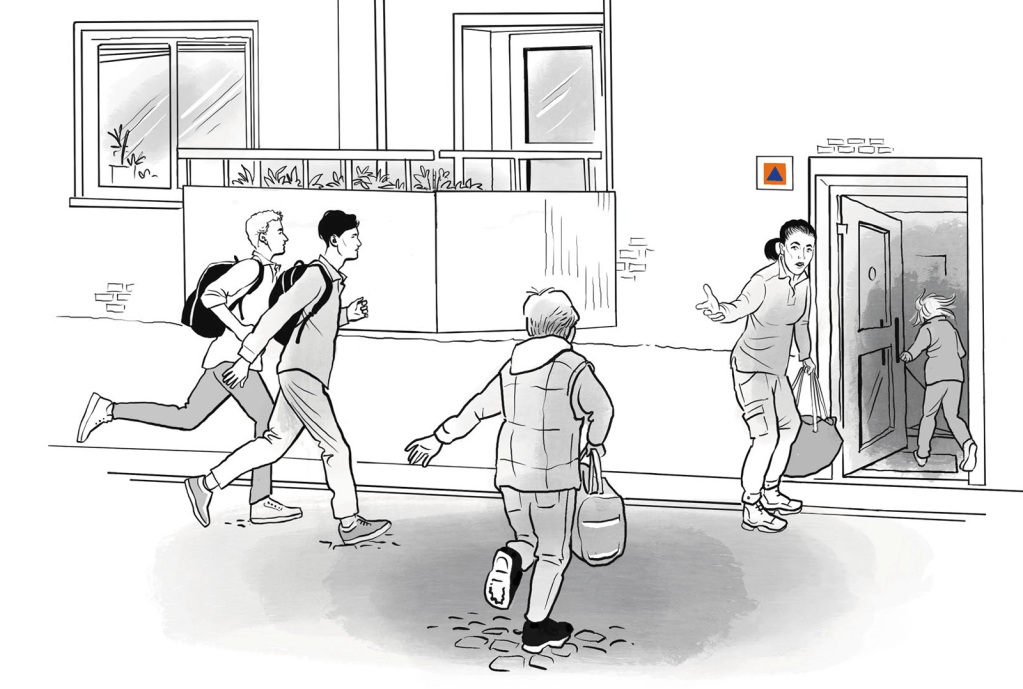
Atomic Anxiety is no longer simply a fear about the apocalypse, it’s a growing preparedness that shapes everyday life. Mahmoud Javadi reflects on what this means in the latest Atomic Anxiety Fellows blog…
The old image of atomic anxiety is easy to recognise: a flash in the sky, a siren, a city gone in minutes. It is the fear of sudden ending. That fear has not disappeared. But it is no longer the main way nuclear danger enters public life.
In Europe today, atomic anxiety is becoming quieter. It appears in advice about water and batteries, in brochures for homes and workplaces, in evacuation planning, and in the new political language of preparedness. The bomb is returning not only as a weapon that might be used, but as a condition around which ordinary life is being organised.
Atomic anxiety in 2026 is not mainly mass panic about an imminent mushroom cloud. It is the steady spread of a practical mindset: governments are planning civilian life under the possibility of extreme destruction.
The important point is not that every emergency measure is really about nuclear war. It is that nuclear danger is now being absorbed into broader systems of resilience, continuity, and civil defence. The fear often arrives indirectly. It comes through the side door.
The European Commission’s Preparedness Union Strategy, presented on 26 March 2025, helps show what has changed. The strategy is built around an “all-hazards” and “whole-of-society” approach. It urges stronger coordination among governments, businesses, and citizens, and it encourages practical measures such as maintaining essential supplies for a minimum of 72 hours in emergencies.
Just as important, it places chemical, biological, radiological, and nuclear threats inside a wider preparedness framework rather than treating them as a separate world. That may sound technical, but its meaning is simple. Nuclear risk is no longer discussed only as an exceptional nightmare. It is being folded into the ordinary grammar of readiness.
This marks a real shift from the older nuclear imagination. In the Cold War, the bomb was often pictured as the event that ended normal life altogether. Today, the possibility of catastrophic violence is being translated into more planning, not less: stockpiles, crisis hubs, public guidance, school lessons, continuity plans, and civil-military coordination.
The public is not constantly told to think about nuclear war in direct terms. Instead, people are told to prepare for crisis, war, and severe disruption in ways that assume the boundary between the unthinkable and the governable has grown thinner.
Sweden offers the clearest example because it makes the nuclear link more explicit than the EU strategy does. In its 2024 brochure In case of crisis or war, Swedish authorities tell readers that “armed conflicts are currently being waged in our corner of the world.” The brochure explains home preparedness, shelters, warnings, and civil defence.
It also states, plainly, that “the elevated global threat level increases the risk that nuclear weapons may be used.” That sentence matters. It ties everyday preparedness to nuclear possibility without turning the document into a dramatic tract about apocalypse. The state is not trying to frighten the public into panic. It is teaching people how to live with danger in a calm, organised way.
That is why this is specifically about atomic anxiety and not just about generic war anxiety. War anxiety fears conflict. Atomic anxiety fears a level of destruction so great that ordinary categories begin to fail. But today that fear is often managed indirectly.
Instead of speaking only in the language of the bomb, governments increasingly speak in the language of continuity: how to keep society functioning, how to keep people informed, how to protect civilians, how to endure shocks that once seemed beyond planning. The nuclear condition has not disappeared inside broader preparedness. It has been blended into it.
The same logic now reaches beyond the household. Sweden’s Civil Defence and Resilience Agency announced that, starting on 20 January 2026, it would distribute Preparedness for businesses – In case of crisis or war to 130,000 workplaces, covering about 85 percent of employees. The brochure advises firms to plan, train, and strengthen resilience for crisis, the threat of war, and war.
This is a telling development. Once preparedness moves from kitchen cupboards to offices, warehouses, and shop floors, anxiety stops being only a private feeling or a topic for strategists. It becomes an organisational duty. Businesses, too, are asked to imagine a world in which severe disruption is not impossible and to prepare to keep society running through it.
The regional picture points in the same direction. On 4 March 2026, Sweden announced that it had signed, together with Denmark, Estonia, Finland, Germany, Iceland, Latvia, Lithuania, Norway, and Poland, a memorandum of understanding on protecting civilians in crisis or, in the worst-case scenario, war. The agreement enables temporary cross-border movement of people and covers joint planning for transport, border controls, reception, registration, and the protection of vulnerable groups; the accompanying memorandum also refers to cross-border evacuations based on the current threat assessment.
This is not proof that Europe expects imminent nuclear use. That would go too far. But it is proof that worst-case thinking has become concrete enough to shape administrative planning across borders. States are preparing not only to deter catastrophe, but to preserve social order if catastrophe spills into civilian life.
There is something prudent in all this, and something unsettling. Prudence matters: a prepared society is less fragile than one built on denial. But preparedness also changes the emotional texture of politics. It teaches citizens, workers, and institutions to treat catastrophe as a normal horizon of planning. That may be necessary. It is also revealing.
The clearest sign of atomic anxiety in 2026 is not that people are once again staring at the sky, waiting for the flash. It is that governments are quietly teaching them how to store, move, work, and endure under its shadow. The apocalypse has not vanished. It has been translated into instructions.
Mahmoud Javadi is a doctoral researcher at the Vrije Universiteit Brussel (VUB), Belgium, where he is involved in the European Research Council-funded project “Competition in the Digital Era: Geopolitics and Technology in the 21st Century” (CODE).
Previously (June 2023 – August 2024), Mahmoud was an AI Governance Researcher at Erasmus University Rotterdam (EUR), contributing to the EU-funded (Horizon Europe) project “Reignite Multilateralism via Technology” (REMIT). He also has experience with the Carnegie Endowment for International Peace, where his research focused on EU external relations.
This blog is part of a series of articles by the Atomic Anxiety in the New Nuclear Age Fellows Cohort. These articles represent the view of the author and not necessarily those of the project as a whole or other individuals associated with the project.
 Atomic Anxiety in the New Nuclear Age
Leave a comment