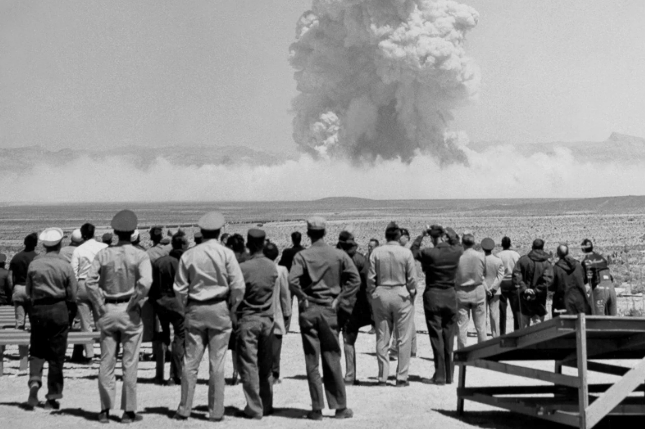
Do people think about how nuclear weapons might affect them? And what’s the impact on politics if they do or don’t? These are some of the questions Dina Tawfik explores in the latest Atomic Anxiety Fellows blog…
When we think of nuclear weapons issues, our attention typically gravitates toward the leadership of states that possess them or are close to possessing them, the treaties and frameworks that govern these weapons, and the ways in which states interact with these structures.
Rarely, however, do we reflect on how the ordinary individual – particularly one from a non-nuclear weapons state in the Global South – might feel a sense of atomic anxiety, or how they think about and engage with these weapons of mass destruction within their own imaginaries and everyday lives.
In a talk on nuclear politics, with participants from the Middle East and North Africa (MENA) and the European Union (EU) regions, I asked: “Who here is a nuclear weapons stakeholder?”
Out of 36 participants only two people raised their hands, and I was otherwise met with blank and puzzled faces. This was surprising because the audience consisted of people from the MENA region – like Algeria, which endured French nuclear tests in the 1960s; Egypt, toward which Israel had allegedly employed nuclear signaling in the 1973 war; Syria and Lebanon, neighbours of Israel, which is known to possess nuclear weapons – and others from European countries which possess nuclear weapons (the United Kingdom and France), and others from NATO states involved in the nuclear sharing program, such as Italy and Belgium.
Despite having little to no background on the topic, the audience seemed to resonate strongly with the parts of the talk that explored how nuclear weapons are normalized, valorized and sexualized in popular culture, as well as the risks of miscalculation, rather than the sections that outlined stockpiles and structures that govern non-proliferation and disarmament frameworks.
These former themes appeared to pique their curiosity as they sparked conversations that continued long after the talk. Perhaps this was in part owed to the immediacy and relatability of cultural narratives, combined with the realization of how easily a miscalculation could trigger catastrophe that would affect them.
So why is it that most people don’t think of themselves as nuclear weapons stakeholders, and how does this fact impact the way people engage in nuclear politics?
I don’t promise anything close to a conclusive answer, but one might argue that patterns of engagement and disengagement with nuclear politics are to some extent shaped by a paradoxical dynamic: a profound sense of detachment from these weapons coexisting with a fascination toward technologies that remain largely opaque, but are known for the scale of destruction they unleash.
This distance is not a mere by-product of an increasingly complex weapons system and the structures that govern them – it is arguably designed in a way that keeps people from being meaningfully engaged in the nuclear sphere.
Back in 1987, Carol Cohn argued that the technical jargon and abstraction that dominates the nuclear sphere exclude people from engagement in nuclear politics. This, among other reasons, may explain why most people do not see themselves as nuclear weapons stakeholders.
But in understanding more about the consequences of nuclear war, people become more aware of their own stakes in nuclear politics. In December 2024, the United Nations General Assembly passed a resolution to establish an Independent Scientific Panel on the Effects of Nuclear War tasked with publishing a report by 2027.
The report is meant to inform policymaking in the nuclear weapons space for the next several decades. However, for those outside the nuclear weapons policymaking sphere, UN expert reports can often be dense and lengthy, making them difficult to engage with. Therefore, we need to make sure that the report is widely reported, and its findings made clear for a general global audience.
Disarmament education more broadly also needs to make its way into classrooms at schools and higher education institutions. Article 12 of the Treaty on the Prohibition of Nuclear Weapons (TPNW) obliges states to promote the norms of the treaty, which offers a foundation for integrating disarmament education into national strategies.
To operationalize this, member states could establish a fund for developing and embedding disarmament education in school and university curricula, as well as for nationwide public awareness campaigns.
The curriculum should enable learners to fully grasp their stakes in nuclear weapons issues. It should also highlight the colonial legacies of nuclear testing, the history of anti-nuclear movements in the Global South, the human and environmental consequences of nuclear testing and war, and the roles regular people have played, and can still play, in shaping policy.
The purpose of this effort would be to broaden the range of perspectives available to the public, moving beyond the traditional military lens and deterrence narratives that often dominate nuclear debates and always serve to justify the existence of nuclear weapons.
Furthermore, while there have been efforts at broadening disarmament beyond a purely technical and standalone field, much more remains to be done to make it more inclusive and relatable to broader audiences.
As the world currently experiences a reversal in nuclear arms reductions, the disarmament community has a critical role to play. Not only by advancing research within its own field, but by more effectively demonstrating how disarmament intersects with broader global peace and security priorities that often garner greater attention such as the environment, gender equality, and economic development.
Dina Tawfik is a PhD student working on nuclear politics in the Middle East as part of the Nuclear politics in the Middle East (NUCLEAR-ME) research project. Her research explores the region’s nuclear condition, challenging dominant narratives about its nuclearity by illuminating perspectives from within the Middle East.
She previously worked at the Cairo International Center for Conflict Resolution, Peacekeeping and Peacebuilding, and the Vienna Center for Disarmament and Non-Proliferation. She holds an M.A in Comparative and Middle East Politics from the American University in Cairo.
This blog is part of a series of articles by the Atomic Anxiety in the New Nuclear Age Fellows Cohort. These articles represent the view of the author and not necessarily those of the project as a whole or other individuals associated with the project.
 Atomic Anxiety in the New Nuclear Age
Leave a comment