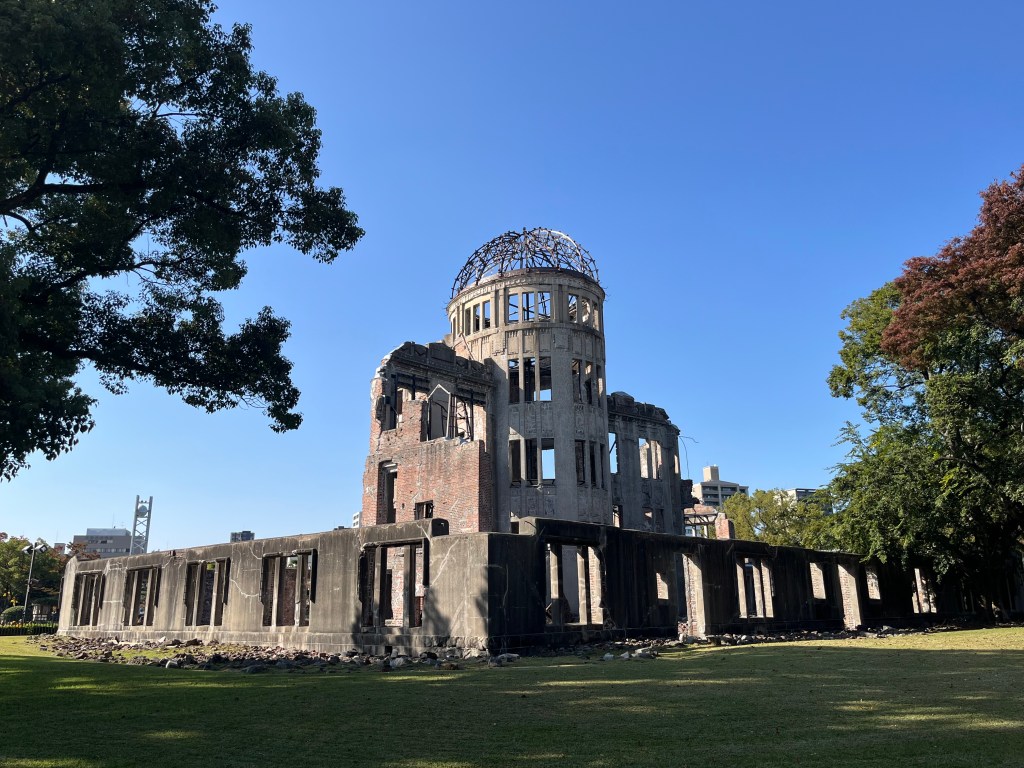
Contrary to what some people might want you to think, hope can be a strategy, writes Sanaa Alvira in our latest Atomic Anxiety fellows blog post. Read on to find out how and why, based on Sanaa’s experience in Hiroshima at the 2025 Pugwash Conference…
In his new book Thinking Historically: A Guide to Statecraft and Strategy (Yale University Press, 2025), Francis J. Gavin makes the case for imbibing what he calls a “historical sensibility” to guide decision-making and improve policy.
This involves not merely studying history, but cultivating a discipline of the mind to engage deeply, seek context and, most importantly, foster empathy in order better understand what may seem unfamiliar to us. As he writes,
“What we have lost, and what we desperately need to reclaim, is a different mode of cognition, a historical sensibility. This is not about memorising dates and facts… It is a temperament that is comfortable with uncertainty, sensitive to context and aware of the powerful, often unpredictable rhythms of the past”
Gavin’s insistence that we cultivate a deeper way of engaging the past came back to me during my recent visit to the Hiroshima Peace Memorial Museum in Japan. Standing in a space shaped by unimaginable horror, I was uncomfortably and unavoidably reminded that we still live in a world with nuclear weapons, weapons that are far more advanced and destructive than anything the museum exhibits could capture.
Today, we are returning to the Cold War-era dynamics of nuclear build-up and signalling. To those of us in the nuclear and nuclear-adjacent fields, this has been an unfortunate (although avoidable) downhill tumble for quite some time now.
To be clear, the current geopolitical scenario is a downhill tumble for all of us, but many understandably do not have the bandwidth to think about existential threats from seemingly abstract weapons when rent is due and groceries are expensive.
You may think that the current state of affairs would be a widespread cause of concern to anybody paying even the slightest attention, but in the laundry list of Bad Things That Affect Me, existential threat from nuclear weapons do not enjoy a feature for many. At best, it gets lumped in with the big, broad bad thing of the General State of Affairs.
On one hand, public understanding of nuclear risks is at an all-time low; on the other, the dissonance between the scale of the danger and our ability to meaningfully contribute towards lowering these risks is at an all-time high. If nuclear weapons are everybody’s problem, then they are nobody’s problem.
I often hear from older colleagues and mentors that the pervasive terror of nuclear war, while once vivid, is quietly evaporating. The atomic bomb is now largely a relic of the past, no longer “giving shape and meaning to all our perceptions,” as historian Paul Boyer said it would.
This leaves us with an odd disjunction: rising atomic threats do not correspond with rising atomic anxiety across populations. We have learned to stop (actively) worrying and live with the bomb.
Gavin boldly states, “Almost everything that has ever happened and everyone who has ever lived is forgotten.” I do not know what it’s like to practice “duck and cover” routine nuclear preparedness drills, nor I have seen a fallout shelter that seemed to be a prevalent part of public consciousness during the Cold War years. This of course is a good thing, until it probably isn’t.
Are we forgetting, or perhaps setting aside, what Hiroshima and Nagasaki were like? No, not the details of dates, death tolls and yields, but – in the spirit of Gavin’s historical sensibility – the human toll, in all its aspects, effects and contexts.
As I looked at exhibits of a human shadow forever etched in stone, the charred and melted tiles, disfigured glassware and burnt clothes of school children at the Hiroshima Peace Memorial Museum, I was confronted with an important reality: nuclear weapons are a very real presence in the world today, affecting the lives of real people, and are not an abstract concept confined to the upper echelons of governments.
Yes, I already knew this – and indeed, we all know it theoretically and intellectually – but my visit to the museum made it more visceral.
I was in Hiroshima attending the 63rd Pugwash Conference on the theme “80 Years After the Atomic Bombing – Time for Peace, Dialogue and Nuclear Disarmament.”
The five-day intensive conference was preceded by a two-day early-career conference organised by the International Student/Young Pugwash (ISYP), where 33 younger participants from 22 countries gathered to share their research on various aspects of nuclear and other weapons of mass destruction.
Although the conversations in and around the sessions were sometimes difficult, they were candid and important. Outside, Trump’s ambiguous threats to resume nuclear testing (which surfaced on-cue during our conference in an unfortunate irony) were added to the long list of nuclear-field grievances.
Despite the abyssal state of affairs, or rather because of it, the conference concluded with the adoption of the Hiroshima Declaration 2025. The declaration is worth a quick read in its entirety, but the last bits are quoted here:
“… No more Hiroshimas. No more Nagasakis. No more war. Japan’s Constitution, Article 9, which renounces war and the use of force, echoes the 1955 Russell– Einstein Manifesto’s appeal to abolish war itself. Together, they stand as enduring beacons of conscience, affirming that true security lies not in arms and the use of violence, but in multilateralism, respect for rule of law, justice, dialogue, and our shared humanity.
Let the Pugwash Conference in Hiroshima 2025 be a turning point towards dialogue, disarmament, and lasting peace for all humankind, guided by the unyielding call of the Russell-Einstein Manifesto: ‘Remember your humanity, and forget the rest.’”
Setting aside the declarations and calls to action, I found the conference uplifting in at least one other important way. Understanding the work and passion of my early-career colleagues (who are also my friends) and learning how they are each contributing towards making this planet a safer place, has been nothing short of rewarding and inspiring.
It’s heartening that the importance of young people taking an active role in tackling these issues is now a recurring theme at such conferences. And in those conference rooms, that ideal felt embodied and tangibly there, providing a real source of hope.
Which brings me to the title of this blogpost, which you may have rolled your eyes reading. In 2006, Senator Hillary Clinton said “hope is not a strategy” to the top US General during his congressional testimony on the situation in Iraq. In 2009, Dr. Benjamin Ola Akande, an economist and scholar wrote an open letter titled “Hope Is Not A Strategy” to President Obama expressing concern on the state of the economy.
It’s also the title of a few books, both old and recent. Although used in different contexts, the phrase captures the same sentiment: hope alone will only get you so far. You need to follow-through with proactive and diligent planning as well as execution.
Of course hope cannot be a strategy if one is to believe such an expression implies blind optimism, false assumptions and a disregard for the very real roadblocks in the way. No, what it instead means is that hope is first a belief in the possibilities, followed by recognition that failures will occur, progress will stall, good judgement will help decide when and how to push or pivot, and that persistence, not naivety, will carry us forward.
It is an audacious outlook that inspires creativity and action, overcoming the paralysis-by-analysis that is generally plaguing everyone and everything.
If anything, having hope that a world without nuclear weapons is possible is a prerequisite for achieving it.
When US and Soviet nuclear arsenals reached gargantuan limits in the 1980s, psychiatrist Robert Jay Lifton wrote, “Awareness, then, involves the full work and play of the imagination. It means imagining danger that is real, but also imagining possibilities beyond that danger.”
Despite the banality of the gruesome, confronting with the horrific possibility of such a reality and believing in our collective ability to make a difference may be what we need to save ourselves.
In the status quo where the weapons are waiting to end the world in an afternoon, holding onto hope for the better is perhaps one’s greatest act of rebellion against it.
We started with Gavin’s historical sensibility, which I think Professor Hunham, from one of my favourite movies The Holdovers (2023), captures simply: “History is not simply the study of the past. It is an explanation of the present”.
By visiting Hiroshima on the 80th anniversary of the atomic bombings, I confronted the historical reality of what nuclear weapons are capable of. I hope this reality continues to anchor not just my work, but also my outlook towards life. And I hope that we hold onto this hope to prevent the past from turning into our future.
Sanaa Alvira is a Research Associate specialising in nuclear policy and related issues at the Centre for Air Power Studies, India, and a Research Assistant at the Centre for the Governance of AI (GovAI).
She is also a Marie Sklodowska-Curie fellow at the International Atomic Energy Agency (IAEA) and a recent graduate of the Non-Proliferation and Terrorism Studies master’s programme at the Middlebury Institute of International Studies at Monterey.
This blog is part of a series of articles by the Atomic Anxiety in the New Nuclear Age Fellows Cohort. These articles represent the view of the author and not necessarily those of the project as a whole or other individuals associated with the project.
 Atomic Anxiety in the New Nuclear Age
Leave a comment