New START, Who Dis? Living with Atomic Anxiety 2.0
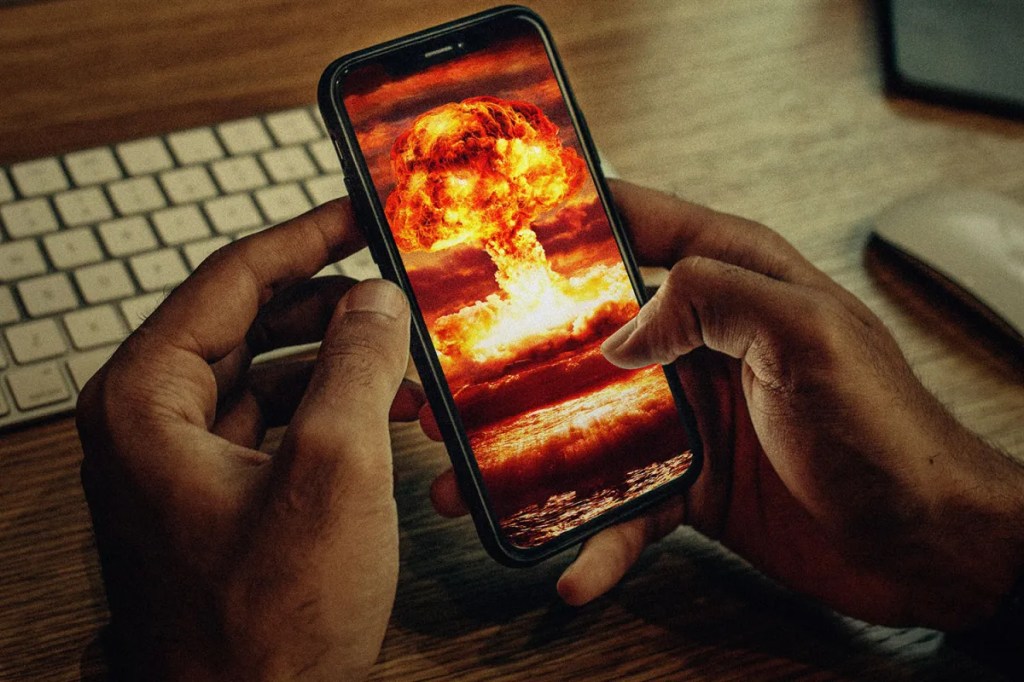
In the second blog post by our 2025 Atomic Anxiety Fellows cohort, Ian Fleming Zhou is doomscrolling with a feeling of ambient atomic anxiety when the phone rings – New START, who dis?…
It’s 89 seconds to midnight according to the Bulletin of the Atomic Scientists. The closest it’s ever been. If this were a movie, “Anxiety” by Doechii plays softly in the background, the perfect soundtrack for a world that’s perpetually one bad headline away from disaster.
The clock, once a Cold War metaphor, now reads like a group chat timestamp ticking through pandemics, wars, cyberattacks, and nuclear threats. The symbolism hits harder in 2025, when “peace and security” sound more like nostalgic relics than diplomatic goals.
If the Cold War gave us mushroom cloud nightmares, the 21st century has given us something more subtle and maybe more dangerous: ambient atomic anxiety. It’s not the kind that makes you build bunkers or duck under desks; it’s the kind that sits quietly in your algorithmic feed between climate doom and celebrity scandals.
The treaties and agreements are still there: the Non-Proliferation Treaty, the Comprehensive Test Ban Treaty, the Treaty on the Prohibition of Nuclear Weapons, even New START – but the vibe? Pure chaos.
The institutions meant to keep us calm are now part of what keeps us anxious. The NPT Review Conferences meant to renew faith in the cornerstone of the nonproliferation regime keep ending in failure and frustration. Each one collapses under the weight of polite statements and unbridgeable divides, reminding us that consensus has become a relic of a bygone era. And the CTBT? We’re still waiting for all Annex 2 states to ratify before it can even enter into force. Really? Nearly three decades later, we are still refreshing the ratification page like it’s 1996.
Meanwhile, the TPNW tries to build a new moral order, but the nuclear-armed states keep ghosting it. The result? Institutions talking past each other while the world outside burns hotter, literally and politically.
We have somehow arrived at a moment when the nuclear system looks both over-managed and completely ungoverned. The acronyms are still doing their rounds at the UN First Committee, but outside those halls, deterrence has become more of a lifestyle than a theory. Everyone is modernizing their arsenals. North Korea’s testing schedule reads like a to-do list. Russia has decided that “suspending” treaties is the new “withdrawing.” China’s arsenal is growing faster than TikTok trends. And the U.S. is stuck between arms control nostalgia and trillion-dollar modernization budgets. It’s giving… deterrence fatigue.
Meanwhile, the so-called “nuclear umbrellas” meant to reassure allies now feel like the thinnest of canopies. South Korea quietly debates the unthinkable. Japan, once firmly non-nuclear, now debates what security means under an increasingly leaky umbrella. Europe wonders if the U.S. nuclear guarantee still holds when American politics can barely guarantee breakfast. The idea of extended deterrence has become a trust exercise in a world where everyone’s fingers are crossed behind their backs.
And then there’s the theatre: the nuclear signaling that’s basically the geopolitical equivalent of subtweeting. Kim Jong Un fires off missiles as seasonal greetings. Putin drops nuclear threats like mixtapes. Somewhere in the Middle East, the ghost of the JCPOA still haunts diplomatic briefings, even as Israel and the U.S. trade strikes on Iranian nuclear sites. The deal is not dead yet, it’s just lying flatlined under the hum of UN paperwork and wishful diplomacy. It’s all part of the modern deterrence aesthetic: dramatic, performative, and algorithm-friendly. We’ve turned existential risk into content.
Arms control and nonproliferation were once twin pillars of stability, but are now having what looks like a messy divorce. Arms control was supposed to manage what already existed; nonproliferation, to stop the spread. Both assumed a shared belief in rationality. But rationality doesn’t trend anymore. The practicality of these frameworks is questioned as modernization plans multiply and disarmament feels more like a hashtag than a horizon. How do you talk about reducing arsenals when everyone’s busy upgrading them?
Maybe this is what Atomic Anxiety 2.0 really is, a kind of low-grade panic that we’ve all normalized. It’s not the fear of the bomb itself but of the systems around it fraying in plain sight. The treaties are relics of a world that no longer exists, yet we cling to them like expired insurance policies as we live with ambient atomic anxiety.
We scroll past headlines about nuclear brinkmanship with the same detachment we reserve for celebrity breakups. The apocalypse, should it come, will probably be livestreamed and we’ll double-tap before doomscrolling to the next thing.
Still, there’s something instructive about this anxiety. The fact that we can feel that quiet hum of unease means that the world hasn’t entirely surrendered to nuclear fatalism. Anxiety, after all, is awareness. And awareness can be action, if we choose it to be. The future of nuclear arms control might not be written in new treaties or summit photo-ops, but in how honestly we confront our denial.
It’s time to stop pretending we’re post-nuclear. Because the truth is, we never left. The Cold War ended, but the bomb stayed, updated, rebranded, re-tweeted. New START, who dis? Same old bomb, new anxieties.
Ian Fleming Zhou, is a Nuclear Policy Researcher. His work focuses on nuclear diplomacy, arms control, and the evolving architecture of global security.
This blog is part of a series of articles by the Atomic Anxiety in the New Nuclear Age Fellows Cohort. These articles represent the view of the author and not necessarily those of the project as a whole or other individuals associated with the project.
 Atomic Anxiety in the New Nuclear Age
Leave a comment