In 1985 the author Paul Boyer used the term “atomic anxiety” in his book By The Bomb’s Early Light. The phrase is mentioned almost in passing, as Boyer talks about the mood in the USA in the immediate aftermath of the American atomic bombing of Hiroshima and Nagasaki. Boyer writes that, after news of the atomic bombing reached the United States,
America was in a “fear psychosis,” said anthropologist Robert Redfield in November 1945; atomic anxiety had become “a nightmare in the minds of men.”
The book then explores how this fear played out across American politics and culture, where in the words of one source that Boyer quotes “the atomic age is here, and we’re all scared to death; you, I, and everyone else” (p.21).
This fear of nuclear weapons wasn’t just a flash in the pan fear, but it shaped the Cold War and now our current moment. As Boyer puts it, the announcement of the first atomic bombings was “a psychic event of almost unprecedented proportions” (p.22) that led to fear, uncertainty, confusion, but also a simultaneous sense that Americans shouldn’t be paralysed by their fears of the bomb shaping the world (p.25).
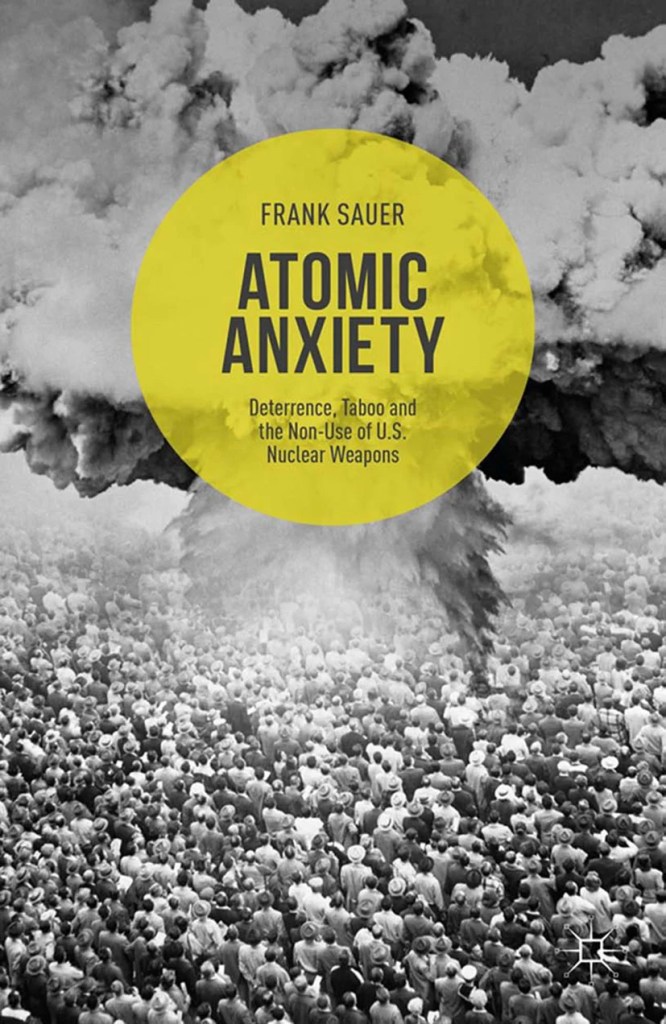
The cover of Atomic Anxiety by Frank Sauer
The idea of atomic anxiety was revisited twenty years later by the scholar Frank Sauer in his 2015 book Atomic Anxiety, that provides a developed conceptualisation and empirical analysis of what atomic anxiety is and how it matters in global politics.
Drawing upon the burgeoning study of emotions in global politics, Sauer develops a definition of atomic anxiety where he understands our individual, embodied fears of nuclear weapons being used as feelings of nuclear fear, whereas atomic anxiety is “the socially shared experience of that particularly ‘nuclear fear’” (p.123).
So whilst we might be able to study individual nuclear fears by using psychological methods and neuroscience, if we want to study the broader political, social, and cultural aspects of atomic anxiety then we can analyse how people – decision makers, activists, the media, the public on social media, etc – represent their fears about nuclear weapons through language or other forms of representation.
The central contribution of Sauer’s insight is that “experiencing atomic anxiety is the emotional springboard of all beliefs that rule against using these weapons, in short, atomic anxiety is the key underlying element of our thinking about nuclear weapons and their use” (p.127), because atomic anxiety contains “deeply and widely felt uncertainties and grueling worries about the survival of the entire human race” and “has been woven deeply into the cultural fabric of modern society” (p.127).
It’s worth quoting one section of Sauer’s book at length because it cuts to the centre of what atomic anxiety is and what it involves. Sauer writes:
“Atomic anxiety holds the preeminent, shared ideas of what a use of nuclear weapons would mean. It means instant horror, vast destruction, total annihilation, dying a horrible death (Boyer, 1994 [1985], pp. 277–278) – death, that is, with a good chance of little to no warning, no time to run or prepare for. From perishing within the blink of an eye in a flash of light, to being ripped apart by a tremendous blast wave, to being set on fire and burned alive, to being buried under a ton of rubble. And while conventional bullets and bombs will kill or maim a person, with nuclear weapons, even surviving this initial onslaught could only mean dying an agonizing, slow death in the aftermath of a nuclear war, from acute radiation sickness, or starvation in a postapocalyptic wasteland, or from contracting cancer a couple of years down the road, or from being buried alive in some fallout shelter. Life itself, should a person survive, might no longer be worth living on the contaminated planet, with DNA damaged by radiation, bringing suffering to yet unborn generations” (p.131).
This is atomic anxiety, and this is the foundation we’re building on in our current work. Forty years on from the term being coined, and a decade on from Sauer’s book-length engagement with the concept, what does atomic anxiety look like today? Is it still significant, or is it eroding?
Are we losing our atomic anxiety? And if we are, does that make the use of nuclear weapons, nuclear accidents, nuclear war, and the end of all life on earth more likely?

 Atomic Anxiety in the New Nuclear Age
Leave a comment